| |
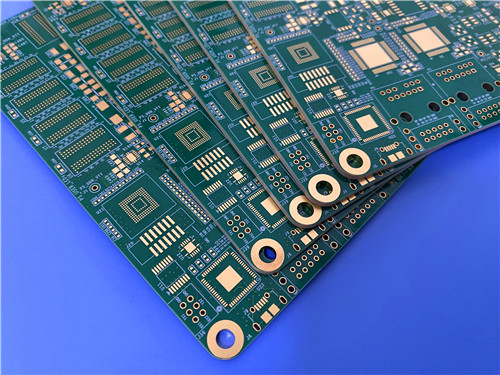
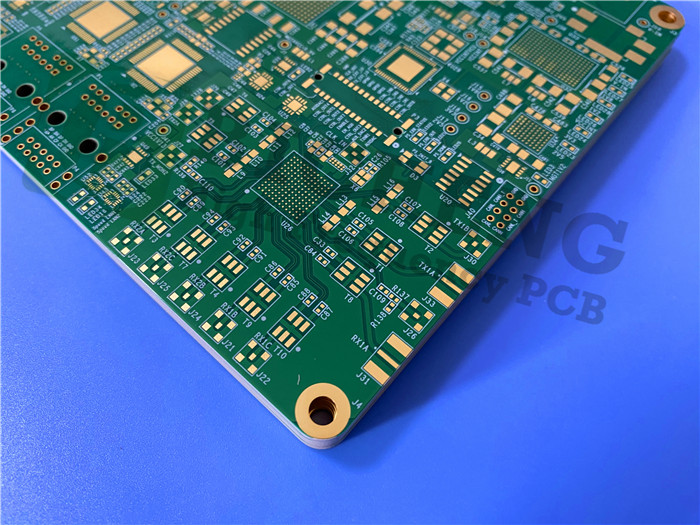
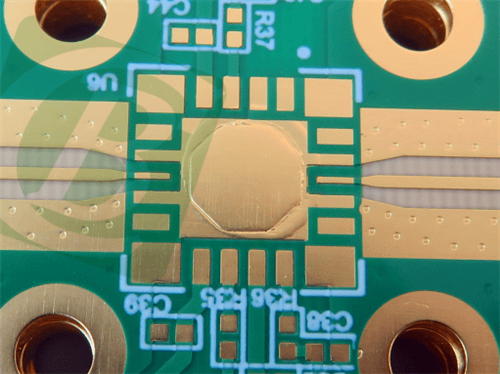
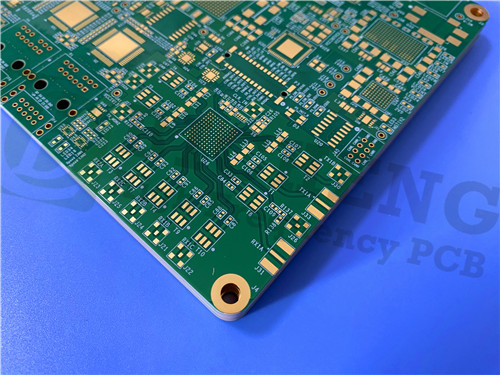
18-Layer M6 High-Speed PCB with ENIG Surface Finish
1.Introduction to Core Technologies
Megtron6 (M6) Material
S1000-2M is a high-performance copper-clad laminate (CCL) from Shengyi Technology, specifically designed for high-layer-count and high-reliability PCB applications.
Key Performance Characteristics:
1.Ultra-Low Dielectric Constant and Loss Tangent: At 10GHz, typical Dk is approximately 3.4-3.6, with Df as low as below 0.002, significantly reducing signal attenuation and distortion.
2.Excellent Signal Integrity: Minimal signal loss ensures integrity over long-distance, high-speed transmissions, supporting extended trace lengths or higher data rates.
3.High Thermal Reliability: Glass transition temperature (Tg) exceeds 185°C with high decomposition temperature (Td), capable of withstanding lead-free soldering processes and ensuring dimensional stability and long-term reliability in demanding environments.
4.Stable Electrical Performance: Dielectric properties remain highly stable across wide frequency and temperature ranges, facilitating precise impedance control.
5.Suitable for High-Layer-Count, Complex Structures: Compatible with prepregs like R-5670G, ideal for manufacturing complex multilayer boards with 18 or more layers, meeting the needs of high-end servers, switches, and optical modules.
What is a High-Speed PCB?
A High-Speed PCB is specifically designed and manufactured for transmitting high-speed digital signals. The "high-speed" characteristic refers not only to high clock frequencies but, more critically, to extremely short signal rise/fall times (typically less than 1 nanosecond), which cause signals to exhibit significant transmission line effects.
Core Challenges and Requirements in High-Speed PCB Design:
1.Impedance Control: Precise control of characteristic impedance (e.g., 50Ω single-ended, 100Ω differential) is essential to minimize signal reflections.
2.Signal Integrity Management: Addressing signal distortion caused by loss, reflection, crosstalk, and ground bounce.
3.Power Integrity Assurance: Providing stable, clean power to high-speed chips and reducing simultaneous switching noise.
4.Strict Stack-up Design: Precise layer planning to provide clear reference planes for high-speed signals, controlling impedance and minimizing crosstalk.
5.Selection of Low-Loss Materials: Such as Megtron6, to reduce dielectric loss effects on high-frequency signals.
6.Implementation of Advanced Processes: Including resin-filled vias and back-drilling to improve via performance and reduce signal attenuation and reflection.
2.PCB Details
| Item |
Specification |
| Product Model | 18-Layer High-Speed PCB |
| Layer Count | 18 Layers |
| Core Material | Panasonic Megtron6 (R-5775G), Tg ≥185°C |
| Prepreg | Panasonic R-5670G (HVLP) |
| Inner Layer Copper | 35μm (approx. 1oz) |
| Outer Layer Copper | 35μm (approx. 1oz) |
| Finished Thickness | 2.013mm |
| Surface Finish | ENIG, Gold Thickness ≥2μ″, Coverage ~29% |
| Solder Mask | Taiyo PSR-2000 CE887M (CE97), Matte Green |
| Silkscreen | White |
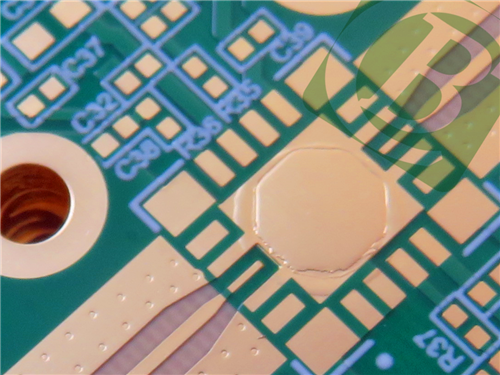
| Special Processes | Through-Hole Resin Filling (Plated Cap) |
| Quality Control | Serial Number, Copper Balance, Impedance Test, Low-Resistance Test |
| Unit Size | 240mm x 115mm = 1 PC |

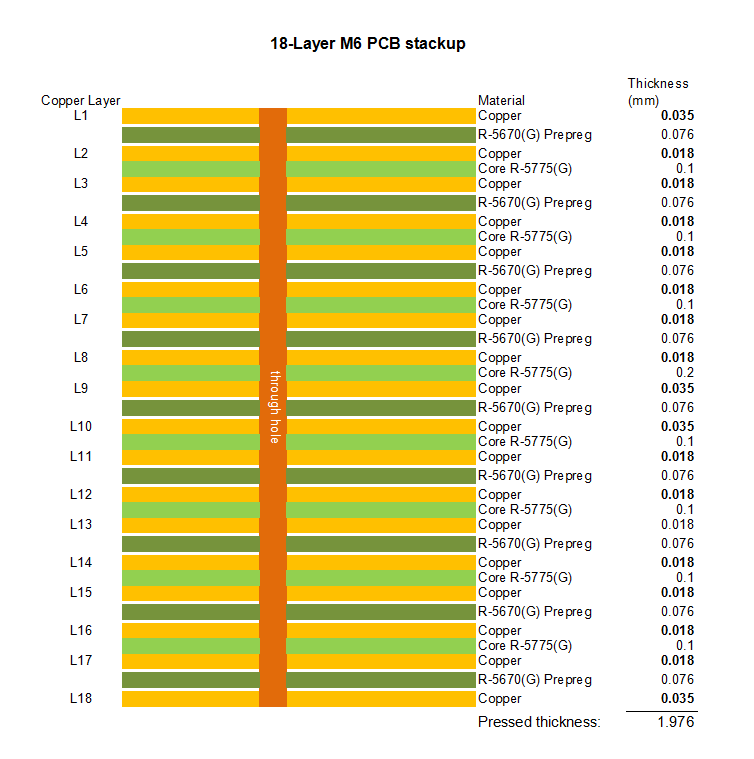
3.PCB Stackup (18-Layer Rigid Structure)
This PCB features a symmetrical 18-layer structure designed to provide optimal transmission environment and impedance control for high-speed signals. Total pressed thickness is 1.976mm.
| Layer |
Material |
Thickness (mm) |
| L1 (Top) | Copper | 0.035 |
| D1 | R-5670(G) Prepreg | 0.076 |
| L2 | Copper | 0.018 |
| C1 | Core R-5775(G) | 0.1 |
| L3 | Copper | 0.018 |
| D2 | R-5670(G) Prepreg | 0.076 |
| L4 | Copper | 0.018 |
| C2 | Core R-5775(G) | 0.1 |
| L5 | Copper | 0.018 |
| D3 | R-5670(G) Prepreg | 0.076 |
| L6 | Copper | 0.035 |
| C3 | Core R-5775(G) | 0.2 |
| L7 | Copper | 0.035 |
| D4 | R-5670(G) Prepreg | 0.076 |
| L8 | Copper | 0.035 |
| C4 | Core R-5775(G) | 0.1 |
| L9 | Copper | 0.018 |
| D5 | R-5670(G) Prepreg | 0.076 |
| L10 | Copper | 0.018 |
| C5 | Core R-5775(G) | 0.1 |
| L11 | Copper | 0.018 |
| D6 | R-5670(G) Prepreg | 0.076 |
| L12 | Copper | 0.018 |
| C6 | Core R-5775(G) | 0.076 |
| L13 | Copper | 0.018 |
| D7 | R-5670(G) Prepreg | 0.036 |
| L14 | Copper | 0.018 |
| C7 | Core R-5775(G) | 0.076 |
| L15 | Copper | 0.018 |
| D8 | R-5670(G) Prepreg | 0.076 |
| L16 | Copper | 0.018 |
| C8 | Core R-5775(G) | 0.1 |
| L17 | Copper | 0.018 |
| L18 (Bottom) | Copper | 0.035 |
| Total | Pressed Thickness | 1.976mm |
4.Typical Applications
Data Centers & Cloud Computing:
High-end server/workstation motherboards for CPU, memory, and high-speed bus interconnects.
Network switches/routers, including 100G/400G/800G Ethernet switch chip interconnect boards and optical module driver boards.
AI accelerator cards/GPU boards meeting extremely high-bandwidth memory interface and chip-to-chip interconnect requirements.
Communication Infrastructure:
5G/6G base station units (AAU, DU) for high-speed digital processing boards and RF front-end interface boards.
Optical transmission equipment, including coherent optical modules and high-speed signal processing boards in OTN devices.
High-Performance Computing & Storage:
Supercomputer interconnect backplanes.
All-flash array controller boards, NVMe over Fabric accelerator cards.
Advanced Test & Measurement Instruments:
Internal signal acquisition and processing boards for high-speed digital oscilloscopes, bit error rate testers, and network analyzers.
Automotive Electronics (Advanced):
Autonomous driving domain controllers, high-resolution vehicle camera processing boards, in-vehicle high-speed Ethernet switches.
Aerospace & Defense:
Radar signal processors, electronic warfare systems, and high-speed data processing units in satellite communication payloads.
5.Quality Assurance
Artwork Format: Gerber RS-274-X
Quality Standard: IPC-Class-2
Availability: Worldwide
6.Conclusion
This 18-layer M6 high-speed PCB, through the use of top-tier Megtron6 low-loss material, a precise 18-layer stack-up design, ENIG surface finish, and advanced processes like through-hole resin filling, achieves exceptional levels of signal integrity, power integrity, and mechanical reliability. Its design thoroughly considers impedance control, loss minimization, and crosstalk suppression, making it a critical hardware foundation for next-generation data centers, high-speed communication networks, and high-performance computing systems. Rigorous quality control measures, including impedance and low-resistance testing, further ensure stable performance under extreme conditions, meeting the growing challenges of data rates and system complexity in the coming years.
|
|
.jpg)
.jpg)